Evergreen History · American Culture
The History of American Football
From nineteenth-century college contests to the passing game, the Super Bowl era, and the modern sport
· About 24 minutes
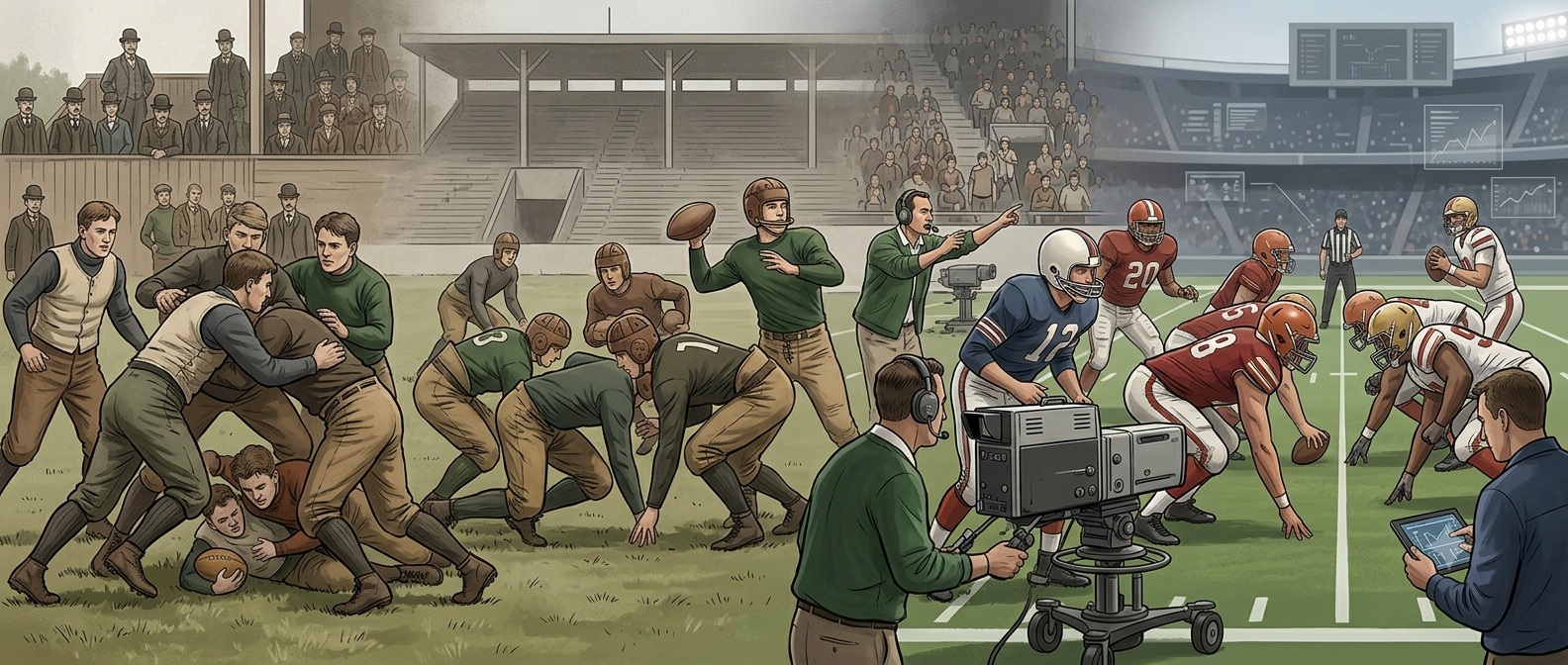
Modern American football did not appear fully formed in one game, one rulebook, or one person's imagination. It emerged over decades as colleges borrowed from different football codes, rule committees separated the game from rugby, safety crises forced reform, and coaches learned to exploit each new possibility. Professional leagues, television, equipment, data, and changing ideas about players' roles transformed it again.
Features that now seem essential—the line of scrimmage, downs, the snap, the forward pass, eleven-player teams, specialized positions, substitutions, formations, and scripted plays—were created or repeatedly revised. The history of American football is therefore less a story of invention at a single moment than a continuing argument about what the game should be.
Who invented American football?
There is no satisfactory one-person answer. Walter Camp is often called the “Father of American Football” because he was central to rules that established the snap, line of scrimmage, eleven-player team, and downs system. Yet the sport grew through the work of many players, coaches, colleges, committees, and league officials. Camp shaped a long process; he did not produce the modern game all at once.
Football before American football
For centuries, “football” named a broad family of games rather than one universal sport. By the nineteenth century, British schools and clubs used different local rules. Association football—the code that became soccer—limited handling and emphasized kicking. Rugby football allowed carrying, tackling, and contests for possession. Even within those families, rules varied.
American colleges inherited that disorder. Students played campus games with locally negotiated rules, different numbers of players, and different ways of moving or scoring with the ball. It is misleading to imagine a straight line from a recognizable British game to today's American code. Several traditions overlapped before a distinct sport took shape.
The 1869 Rutgers–Princeton game
On November 6, 1869, Rutgers and Princeton met in New Brunswick, New Jersey, in what is commonly regarded as the first intercollegiate football game in the United States. That makes it a useful starting point, but not a first performance of modern American football. The teams used modified London Football Association rules, played with twenty-five men per side, and advanced a round ball mainly by kicking. The contest looked substantially more like an association-style game than a present-day football game.
Its significance lies in organized competition between colleges. Once schools began arranging matches, their incompatible rules became a practical problem. Regular competition created pressure for agreements about the field, scoring, player numbers, and what kinds of contact or ball handling were permitted.
The shift toward rugby-style football
During the 1870s, influential colleges moved toward games that allowed carrying and tackling. Harvard's encounters with McGill University in 1874 were especially important. Harvard played its “Boston game,” while McGill brought a rugby-derived Canadian code. The schools tried both styles. Harvard found the running-and-tackling game compelling, and rugby-like rules spread among eastern colleges through later matches and conventions.
This was another transition, not a clean founding event. Rugby supplied the scrum, possession contests, and carrying game from which American rules could depart. The decisive development came when rule makers replaced rugby's relatively fluid struggle for the ball with a controlled method of restarting play.
Walter Camp and the framework of a new game
Walter Camp played for Yale and spent decades on intercollegiate rules committees. His influence was unusually sustained: he proposed changes, argued for standardization, wrote about the sport, and helped define how generations understood it. In 1880, reforms associated with Camp reduced teams from fifteen players to eleven and established a scrimmage procedure in which one side put the ball into play. In 1882, a team was required to advance five yards in three downs or surrender possession.
These rules did not arrive as a finished package. Distances, scoring values, field dimensions, and passing rules continued to change. In 1906, teams were required to gain ten yards rather than five in three downs; in 1912, a fourth down was added, producing the four-downs-for-ten-yards structure familiar today. Camp's importance rests in helping to create the game's organizing logic, not in inventing every later feature.
The line of scrimmage changes everything
The line of scrimmage is the imaginary line across the field through the ball before a play begins. Establishing possession on one side of that line separated offense from defense. The center's controlled snap replaced the uncertain rugby scrum as the normal beginning of action.
That pause created one of American football's defining units: the play. Teams could arrange themselves in formations, assign a job to each player, signal a coordinated action, and evaluate the result before lining up again. Coaches could plan sequences rather than merely respond to continuous motion. Blocking patterns, backfield movement, defensive alignment, and deception all grew from the repeatable start provided by scrimmage.
Downs and distance
A down is one period of action, usually beginning with a snap and ending when the ball becomes dead. Limiting the offense to a set number of downs prevented a team from holding the ball indefinitely. If it gained the required distance, it earned a new series; if not, possession passed to its opponent.
That simple framework made field position and risk central to strategy. A team had to consider how much distance remained, whether to run or try a pass, and whether a later down should be used to punt or attempt a field goal. Today's four-down system is the descendant of those nineteenth-century anti-stalling rules. Readers new to the present game can continue with a visual guide to how downs work today.
Danger, reform, and the forward pass
Football becomes dangerous
By the late nineteenth century, football attracted large crowds and fierce institutional loyalty. It also produced serious injuries. Rule changes that organized possession made planned tactics possible, but some of those tactics concentrated force. Mass formations packed players tightly around the ball, while limited protective equipment and permissive contact rules exposed players to crushing collisions. Critics, physicians, parents, and college leaders questioned whether the sport belonged on campuses.
The crisis of 1905
The debate reached a crisis in 1905 after another season of deaths and severe injuries associated with football. President Theodore Roosevelt, an advocate of strenuous sport, summoned representatives of Harvard, Yale, and Princeton to the White House and pressed them to curb brutality and honor the rules. He did not personally write the new code, and saying he single-handedly “saved football” exaggerates his role. His intervention added political pressure to a reform movement already involving educators, coaches, and administrators.
A wider meeting of colleges organized rule reform. The Intercollegiate Athletic Association of the United States was formally established in 1906 and took the name National Collegiate Athletic Association in 1910. Changes opened the field, restricted some dangerous mass play, and legalized a new method of advancing the ball: the forward pass.
The forward pass
A forward pass sends the ball through the air toward the opponent's goal line. It became legal in 1906 partly because reformers hoped that spreading play would reduce the concentrated collisions of mass formations. Early rules made passing risky. An incompletion could carry a severe penalty, restrictions limited where the ball could be thrown or caught, and the rounded ball was not yet optimized for accurate spirals.
The pass therefore did not instantly create modern offense. Teams used it selectively while rule makers gradually removed constraints. Over time it forced defenses to protect both width and depth. It elevated the quarterback's decision-making role, encouraged specialized receivers, demanded pass protection, and produced route combinations designed to place defenders in conflict. The history explains why passing exists; a guide to modern passing concepts shows how today's routes work together.
Early passing pioneers
Claims about the “first” forward pass depend on definitions: first attempt, first legal completion, first touchdown, or first sustained passing offense. Saint Louis University coach Eddie Cochems and player Bradbury Robinson were among the early pioneers who tested the legalized pass in 1906. Their experiments demonstrated that it could be more than a desperate novelty.
Notre Dame did not invent the pass. Its 1913 victory over Army nevertheless became a national demonstration of a polished aerial attack. Quarterback Gus Dorais repeatedly connected with receivers including Knute Rockne, combining passing and running to defeat a prominent eastern team. The publicity showed that preparation, timing, and receiver patterns could make the pass systematic rather than accidental.
Professional football emerges
College football initially supplied the sport's leading teams, traditions, and national attention. Professional football developed more unevenly through athletic clubs and town teams. Payments were sometimes hidden, and rosters could change from week to week. A ledger documenting William “Pudge” Heffelfinger's $500 payment to play for the Allegheny Athletic Association in 1892 is commonly treated as the earliest authenticated evidence of a paid professional player—not proof that no one had ever been paid before.
Regional competition grew, but unstable finances, bidding wars, and inconsistent schedules limited it. In September 1920, club representatives formed the American Professional Football Association in Canton, Ohio. The organization sought orderly contracts, common rules, and credible championships. It adopted the name National Football League in 1922. The early league, with fragile franchises and modest revenues, bore little economic resemblance to the modern NFL.
The NFL develops an identity
During the 1920s and 1930s, better organization, recognizable stars, urban franchises, and championship competition made professional football more durable. The league also began distinguishing its product from the college game. A disputed 1932 indoor playoff helped prompt major changes for 1933: the NFL created its own rules structure, permitted a forward pass from anywhere behind the line of scrimmage, required the ball to be placed on the hash marks after plays near the sideline, moved goalposts to the goal line, divided into two divisions, and staged an official championship game.
The hash marks—short lines running parallel to the sidelines—prevented the next snap from occurring at an extreme edge of the field. That gave offenses more usable space to either side. The freer passing rule and new ball placement encouraged offense while asserting that the professional game could adapt rules to its own needs.
Formations, specialization, and the quarterback
A formation is the arrangement of players before the snap. Early offenses often concentrated backs behind an unbalanced line. The single wing, associated especially with coach Glenn “Pop” Warner, used direct snaps, powerful blocking angles, deception, and several possible ball carriers. It was not one fixed play but a family of structures suited to an era when rushing dominated.
The T formation placed the quarterback directly behind the center, with three backs forming the top of a “T.” Its roots were old, but Clark Shaughnessy, George Halas, and other coaches modernized it with motion, quick handoffs, fakes, and passing. Stanford's success under Shaughnessy and the Chicago Bears' 1940 championship performance accelerated adoption. Bears quarterback Sid Luckman showed how a player under center could coordinate the backfield, disguise ball handling, and attack through the air.
Formations kept changing because coaches sought leverage, clearer passing lanes, better protection, and uncertainty for defenders. Split ends widened away from the line; backfields shifted; later shotgun sets placed the quarterback several yards behind center. What began with the line of scrimmage became a visual language of alignment. A concise guide to modern offensive formations explains the descendants of that history without turning the past into a playbook.
Specialization changes the players
For much of football's early history, players stayed on the field for offense and defense and might also kick. Substitution rules varied and were often restrictive. Wartime roster pressures briefly encouraged flexibility, but the NFL's restoration of unlimited substitution in 1950 firmly opened an era of separate offensive and defensive units. College football moved through its own changes toward two-platoon play.
Specialization made positions more distinct. Quarterbacks directed offenses; running backs carried and caught; wide receivers worked in space; tight ends combined receiving and blocking; offensive linemen divided interior and edge responsibilities. Defensive linemen attacked blocks, linebackers operated between the line and secondary, and defensive backs covered receivers and supported the run. Kicking units became a third phase. For present-day roles, see the illustrated overview of football positions.
War, television, and a national audience
Football during and after World War II
World War II removed players and coaches for military service, led some colleges to suspend or reduce programs, and forced professional teams to improvise with smaller rosters and temporary combined squads. Military teams also played high-level football. The war did not affect every program alike, but it disrupted the sport's institutions and personnel.
After 1945, returning veterans, expanding universities, stronger professional clubs, and new media helped football grow. The rival All-America Football Conference challenged the NFL before three of its teams joined the older league in 1950. That year the NFL restored unlimited substitution, while television deals began carrying selected games beyond their home markets.
The television revolution
The first televised professional game was an experimental 1939 broadcast seen by a small New York-area audience. Television's larger effect arrived after the war. Football fit the medium: each play provided a compact burst of action followed by time for commentary, replays, diagrams, and advertising. Multiple camera angles made formations and collisions visible in ways that a distant stadium seat could not.
In 1950, the Los Angeles Rams arranged broadcasts of all their games, and CBS began showing selected regular-season games in multiple markets. The NFL Championship Game was televised coast to coast in 1951. As national broadcasts, color television, instant replay, and prime-time scheduling developed, professional football changed from a collection of regional attractions into shared national programming. This growth belonged to a wider history of television becoming a mass medium.
The 1958 NFL Championship Game
On December 28, 1958, the Baltimore Colts defeated the New York Giants at Yankee Stadium in the first sudden-death overtime of an NFL championship game. A national NBC audience saw Johnny Unitas lead a late tying drive and then a methodical overtime possession ending in Alan Ameche's touchdown.
The game is famously nicknamed “The Greatest Game Ever Played.” That label is a judgment, not a measurable fact, but its historical importance is clear. Drama, star players, overtime, and national television combined at a moment when the medium and the league were expanding together. The game did not create professional football's popularity by itself; it gave that rise an enduring public symbol.
The AFL, merger, and Super Bowl era
The American Football League began play in 1960 after the established NFL had resisted several prospective owners and markets. The AFL competed for players, placed franchises in growing cities, embraced television, and cultivated an open offensive identity. Competition drove salaries and attention upward while showing that a rival could survive.
After costly competition, the leagues announced a merger agreement on June 8, 1966. They retained separate regular-season schedules through 1969 but began a common draft and an annual championship between league winners. Full integration in 1970 created the American Football Conference and National Football Conference within one expanded NFL.
The birth of the Super Bowl
The first interleague title game, played in January 1967, was formally the AFL-NFL World Championship Game. “Super Bowl” circulated as a convenient nickname and was later adopted officially; the NFL recognized the title by the third game in January 1969. Presenting the first contest as if it already possessed today's branding and cultural weight compresses a gradual development.
Over time the championship became more than a game. Coordinated national broadcasting, elaborate advertising, halftime entertainment, and annual ritual turned it into a major cultural event even for many people who did not follow the regular season. Its rise illustrates how league organization and media could transform a championship into a shared spectacle.
Strategy from the 1960s to the modern passing game
Football in the 1960s and 1970s often emphasized running, field position, and defense, but the period was strategically diverse. Coaches refined zone defenses, in which defenders guarded areas rather than following only one receiver, and built more sophisticated fronts and blocking systems. Specialized staffs broke the game into position groups and situations.
Rules helped determine which tactics succeeded. In 1978, the NFL limited most defender contact with an eligible receiver to the first five yards beyond the line of scrimmage. It also interpreted pass blocking to allow offensive linemen to extend their arms and use open hands. Receivers gained more freedom downfield, and quarterbacks received more sustainable protection. These changes did not eliminate running or defense, but they shifted incentives toward passing.
Bill Walsh and the West Coast offense
Bill Walsh developed his offense through earlier coaching work before becoming head coach of the San Francisco 49ers in 1979. The system associated with him used precise timing, disciplined footwork, and shorter passes to advance the ball reliably. Receivers could turn accurate throws into additional yards after the catch, while formations and personnel forced defenders to reveal or adjust their intentions.
Walsh did not invent every idea later labeled “West Coast offense,” and the name has been applied loosely. His historical influence came from organizing existing and adapted concepts into a teachable system, connecting play design to practice detail, and producing a broad coaching tree. Passing could function as a controlled method of possession rather than only a long-distance gamble.
The rise of the modern passing game
From the 1980s through the 2000s, offenses used more multi-receiver sets, shotgun snaps, motion, and layered route combinations. Quarterbacks were asked to process coverage before and after the snap. Defenses responded with specialized pass rushers, extra defensive backs, and disguised pressure. A nickel defense normally replaces a front-seven player with a fifth defensive back; a dime package adds a sixth.
The pattern was cyclical. When an offense found space, defenses changed personnel or coverage. When defenses became lighter and faster, offenses could answer with runs or heavier groups. Football history cannot be reduced to a march toward more passing; it is a continuing exchange of problems and countermeasures.
College influence and the spread era
Ideas flow in both directions between college and professional football. College coaches expanded shotgun option systems, no-huddle tempo, wide formations, and later run-pass options, in which a quarterback reads a defender before deciding whether to hand off or throw. Professional coaches borrowed useful elements, adjusted them for different rules and athletes, and combined them with older concepts.
Spread formations distribute eligible receivers across more of the field. That spacing can pull defenders away from the tackle box, clarify a quarterback's read, open passing lanes, or make running space inside. “Spread” describes a family of approaches rather than one offense. Its influence demonstrates how coaches borrow, adapt, and recombine ideas instead of tracing every innovation to a single inventor.
Defense and special teams evolve too
Defenses changed whenever offenses changed the geometry of the field. Early fronts crowded the line against powerful rushing formations. As passing expanded, linebackers had to balance run support, coverage, and pressure. Defensive backs refined man coverage, following assigned receivers, and zone coverage, dividing the field into areas. Coordinated blitzes sent unexpected rushers, while disguised alignments attempted to make one coverage look like another before the snap.
Extra defensive-back packages became normal responses to multiple receivers. Defensive coordinators also developed hybrid players who could cover like a back and tackle near the line. The recurring sequence—offensive innovation, defensive response, offensive counter-response—is one of the central engines of the sport's history. The modern alignment side of that story continues in a visual guide to defensive fronts.
Special teams
Kicking has never been merely an interval between offensive and defensive possessions. In early football, kicking and territorial advantage were foundational. Punts traded possession for field position; field goals offered scoring when a drive stalled; kickoffs restarted play; returns could reverse the field. Specialized kickers, punters, returners, coverage players, and long snappers emerged as substitution expanded.
Rule makers have repeatedly moved goalposts and kickoff lines, restricted blocking formations, and adjusted touchbacks and returns. The details differ among professional, college, high school, and other codes. Historically, the common purpose has been to balance field position, scoring, entertainment, and safety.
Equipment, race, and football communities
Equipment changes
Nineteenth-century players wore little standardized protection. Soft leather headgear, padding, and uniforms developed gradually; molded helmets, facemasks, stronger shells, synthetic materials, and more specialized pads followed during the twentieth century. Equipment changed how impacts were absorbed and how players protected the face and body.
Protection also created new questions. Heavier and harder equipment can alter how players feel able to collide. No helmet can remove all brain movement inside the skull, and equipment alone cannot solve the sport's safety problems. Rules, tackling instruction, medical knowledge, practice design, and a culture that encourages injury reporting interact with design.
Race and integration
Black athletes participated in early professional football, but integration was not continuous. Fritz Pollard and Bobby Marshall were among the Black players in the new league in 1920, and Pollard also became an early head coach. After a small number of Black players appeared through 1933, the NFL excluded them from 1934 through 1945.
Professional football was reintegrated in 1946. The Los Angeles Rams signed Kenny Washington and Woody Strode, while the Cleveland Browns of the rival All-America Football Conference signed Bill Willis and Marion Motley. Integration then proceeded unevenly; some franchises waited many more years. This history formed part of the broader, contested desegregation of American professional sports, not a simple story of inevitable progress.
College football as an American institution
College football should not be treated merely as a training ground for the NFL. It developed its own regional rivalries, bands, traditions, bowl games, conferences, and claims to national championships. Alumni loyalty and campus identity made Saturday football culturally important even where professional teams were distant. Different regions built distinct styles and traditions, and college rules sometimes diverged from professional ones.
High schools, youth organizations, and community clubs carried the sport into local life. In some towns, school football became a major shared ritual; elsewhere it remained one activity among many. Its place has never been uniform across the United States, but its school-based structure gave American football a reach beyond professional spectatorship.
Safety, technology, and continuing change
Concussions and rule reform
Concern about head injury is not new, but scientific attention to concussion and repetitive head impacts intensified from the late twentieth century onward. A concussion is a brain injury; repetitive impacts may matter even when each one does not produce an immediately diagnosed concussion. Research continues to examine exposure, short- and long-term outcomes, and the limits of available evidence.
Professional, college, high school, and youth organizations have changed contact rules, practice limits, medical protocols, and return-to-play procedures. Equipment testing and coaching emphasis have also evolved. These measures represent continuing attempts to reduce risk, not proof that the problem is solved. The safety debate echoes 1905 in one respect: public acceptance of football still depends partly on whether institutions can change the game when evidence reveals harm.
Technology changes football
Coaches once relied on observation, handwritten diagrams, and limited film. Successive generations gained game film, sideline photography, video replay, digital cutups, searchable data, electronic playbooks, and player-tracking systems. Helmet communication changed how plays reached quarterbacks and, later, designated defenders. Instant replay altered officiating by allowing certain decisions to be reviewed.
Technology affects preparation as much as performance. Scouts can compare thousands of plays, coaches can isolate tendencies by formation or situation, and players can study opponents on portable devices. Fans use many of the same camera angles and diagrams, making strategy more visible outside team facilities.
Analytics and fourth-down decisions
Quantitative analysis adds historical outcomes and probability models to coaching judgment. On fourth down, for example, a team can compare the expected consequences of punting, attempting a field goal, or trying to retain possession. The model does not make the decision by itself: score, time, weather, players, and an opponent's strengths still matter.
The broader change is methodological. Football strategy increasingly combines experience and film study with large datasets. The questions remain old—risk, field position, possession—but the evidence used to answer them has expanded.
An international product and the growth of flag football
Broadcasts, overseas professional games, military and expatriate communities, development programs, and digital media have built audiences outside the United States. American football remains far less globally dominant than association football, and interest varies widely by country. Still, international leagues and fan communities show that the game is no longer only a domestic product.
Flag football removes tackling and uses the pulling of a flag to end a play. It is a related code with its own rules, spacing, and strategy, not merely a lesser version of tackle football. In 2023, the International Olympic Committee approved flag football for its Olympic debut at the Los Angeles 2028 Games, connecting the football family to the longer history of the modern Olympics. Its rise is another reminder that “football” remains a changing family of games.
What changed the most?
Ten transformations most clearly separate modern American football from its nineteenth-century ancestors:
- The line of scrimmage separated possession and made repeated set plays possible.
- Downs and distance imposed a measurable task and structured risk.
- The forward pass expanded the field vertically and horizontally.
- Specialized positions divided increasingly complex responsibilities.
- Free substitution enabled separate offensive, defensive, and kicking units.
- Formations and scripted plays turned alignment and sequence into strategic tools.
- Professional league organization stabilized schedules, contracts, and championships.
- Television created national audiences and reshaped presentation and economics.
- Continuing rule reform changed the balance among safety, offense, defense, and kicking.
- Data and digital technology transformed preparation, officiating, and analysis.
None of these changes acted alone. The modern game is their cumulative result, continually revised as a rule change produces a tactical response and a new response produces another reform.
Timeline: major milestones in American football history
Early football and the modern game
| Feature | Early football | Modern American football |
|---|---|---|
| Rules | Varied by school, club, and individual match | Standardized within distinct professional, college, high school, youth, and flag codes |
| Line of scrimmage | Absent from the earliest college contests; rugby-style scrums later used | Organizes nearly every offensive and defensive scrimmage play |
| Forward pass | Prohibited before 1906, then restricted and risky | A fundamental option supported by specialized protection, routes, and coverage |
| Positions | Players commonly handled several roles and played both ways | Highly specialized offensive, defensive, and kicking responsibilities |
| Substitution | Often tightly limited under changing rules | Extensive personnel changes between situations |
| Formations | From loose local arrangements to concentrated rugby-derived structures | Numerous offensive and defensive families, often changed before the snap |
| Coaching | Small staffs and less differentiated instruction | Large staffs divided by phase, position, and situation |
| Media | Spectators and local or regional newspapers | Television, streaming, replay, and digital analysis |
| Analysis | Observation, diagrams, experience, and limited film | Video, tracking data, probability models, and coaching judgment |
From football history to the modern game
History explains why football contains downs, formations, specialized positions, running plays, passing combinations, defensive fronts, and coverages. It shows that each feature answered an earlier problem: how to restart possession, prevent stalling, open crowded play, allocate work, or respond to an opponent's innovation.
That is different from seeing how eleven assignments fit together during one modern play. The historical question is how did this structure develop? The tactical question is what is each player doing now?
Companion Resource
Explore how today's game works
OpenPlay Football continues from history into the mechanics of the current game, with beginner guides to personnel groups, running plays, pass protection, coverages, and visual playbook diagrams.
Key takeaways
- American football evolved gradually from several football traditions rather than being invented all at once.
- The 1869 Rutgers–Princeton game is a useful starting point, but it did not resemble the modern sport.
- Walter Camp was central to structural reforms, while many other people and institutions continued the work.
- The line of scrimmage and downs system created repeatable, planned plays.
- The forward pass became transformative only through decades of rule changes and tactical development.
- Professional football needed decades of organization, competition, and media growth to achieve national prominence.
- Offensive innovation repeatedly produced defensive adaptation and another offensive response.
- Rules, equipment, safety research, media, and technology continue to change the game.
Explore More
Related history from the archive
The First College Football Game: Rutgers vs. Princeton, November 6, 1869
Rutgers College and the College of New Jersey, widely known as Princeton, met in New Brunswick, New Jersey, for the first intercollegiate football game. The schools negotiated the rules for the contest, fielding 25 players per side and using a round ball under rules derived from the London Football Association. Players advanced the ball chiefly by kicking rather than by carrying it, making the game far closer to association football than to the modern American sport. Rutgers won by six goals to four.
November 23, 1876: American College Football Begins to Standardize Its Rules
Representatives from Columbia, Harvard, Princeton, and Yale met at the Massasoit House in Springfield, Massachusetts, to agree on a common framework for intercollegiate football. Their rules drew heavily on rugby, reflecting the shift away from the association-style game Rutgers and Princeton had played in 1869. The convention provided leading colleges with a shared basis for competition even though the American game remained far from its modern form and continued to change through later rules committees.
September 17, 1920: The Founding of the League That Became the NFL
Representatives of professional football clubs met in the Canton, Ohio, automobile showroom of Canton Bulldogs owner Ralph Hay and organized the American Professional Football Association. The new association sought to bring order to a sport troubled by escalating salaries, players moving freely among teams, and inconsistent club arrangements. The representatives elected celebrated athlete Jim Thorpe as the association's first president. In 1922, the organization adopted the name National Football League.
December 28, 1958: The NFL Championship Game That Helped Transform Pro Football
The Baltimore Colts and New York Giants met for the NFL championship at Yankee Stadium before a national television audience. Baltimore quarterback Johnny Unitas led a late drive that set up Steve Myhra's tying field goal with seven seconds left in regulation. In the first sudden-death overtime in an NFL championship game, the Colts drove 80 yards before Alan Ameche scored from one yard out. Baltimore won 23-17 in a contest later celebrated as the 'Greatest Game Ever Played.'
January 15, 1967: The First Super Bowl
The NFL champion Green Bay Packers and AFL champion Kansas City Chiefs met at the Los Angeles Memorial Coliseum in the first AFL-NFL World Championship Game. Green Bay broke open a close game after halftime and won 35-10 behind quarterback Bart Starr and receiver Max McGee. CBS and NBC both televised the matchup, the first game between teams from the rival leagues. The event was only later designated Super Bowl I.
Sources and further reading
- Football: the Harvard–McGill games, McGill University Libraries.
- Thanksgiving, Football, and the Emergence of an American Game, Library of Congress.
- Walter Camp, National Football Foundation and College Hall of Fame.
- The History of the NCAA, National Collegiate Athletic Association.
- Notre Dame Football, 1913, University of Notre Dame Archives.
- Pre-NFL professional football, 1892–1919, Pro Football Hall of Fame.
- The 1920 founding of the APFA, Pro Football Hall of Fame.
- The first playoff game and the NFL's 1933 rule changes, Pro Football Hall of Fame.
- Football chronology, 1940–1959, Pro Football Hall of Fame.
- The AFL–NFL merger agreement, Pro Football Hall of Fame.
- The 1978 NFL rule changes, Pro Football Hall of Fame.
- African-American pioneers in professional football, Pro Football Hall of Fame.
- Concussion safety and management, National Collegiate Athletic Association.
- Consequences of repetitive head impacts and multiple concussions, National Academies Press and National Library of Medicine.
- Flag football at the Los Angeles 2028 Games, LA28.